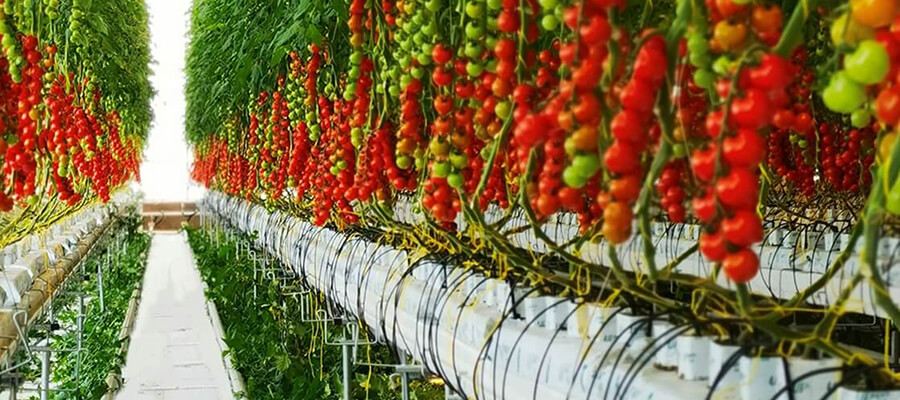

Exploring how innovative rootstocks, fruit quality and cultivation strategies could create new opportunities for commercial tomato producers.
Can a Different Rootstock Create a Different Tomato?
For many commercial greenhouse tomato growers, competition has traditionally focused on yield, production efficiency, disease resistance and cost per kilogram.
But as markets become increasingly competitive, another question deserves attention:
What if growers could create greater market value by changing how tomatoes are grown, rather than simply producing more of them?

An interesting example comes from China, where agricultural researchers have explored wolfberry grafted tomatoes by grafting tomatoes onto wolfberry (Lycium) rootstocks. Wolfberry-Grafted Tomatoes represent an emerging tomato grafting innovation.
Wolfberry, commonly known as goji, and tomato belong to the Solanaceae family but are different genera. Combining them through grafting presents technical challenges, yet research and field demonstrations have shown promising possibilities for this tomato grafting innovation.
An Unusual Combination: Wolfberry Roots and Tomato Fruits
In conventional commercial tomato production, grafting is commonly used to improve disease resistance, root vigor and tolerance to challenging growing conditions.
Wolfberry–tomato grafting introduces a different rootstock tomato rootstock option.
Researchers at Zhejiang University have reported trials involving wolfberry–tomato plants with strong growth, improved tolerance to challenging environmental conditions and distinctive fruit quality.
Separately, researchers at Nanjing Agricultural University's Suqian Research Institute reported successful production of wolfberry grafted tomatoes in greenhouse conditions.
Their reported observations included smaller fruits, thinner skins, stronger aroma and an increase of approximately 20% in soluble solids content compared with the relevant control.
These findings are interesting because they connect tomato rootstock selection with characteristics that consumers may actually notice.
However, soluble solids content is only one aspect of flavor. Overall eating quality also depends on acidity, aroma, texture, cultivar and growing conditions,, all of which affect greenhouse tomato quality
From Rootstock Performance to Product Differentiation
The commercial opportunity extends beyond the grafting technique itself.
A greenhouse operator evaluating this approach might consider three potential benefits.
1. Distinctive fruit quality
Flavor, texture and aroma can help support premium tomatoes production,letting high-value tomatoes stand out in markets where many products look similar.
2. Greater cultivation flexibility
Research has reported potential benefits in plant vigor and tolerance to certain environmental stresses. These characteristics may be relevant to growers managing seasonal temperature changes or longer production cycles while maintaining consistent greenhouse tomato quality
3. New market positioning
A distinctive growing approach may support premium tomato production, specialty retail programs and stronger communication with consumers.
The key is not simply to introduce an unusual tomato. It is to develop a product with measurable quality advantages that customers are willing to pay for,a goal of this tomato grafting innovation
What Should Commercial Growers Evaluate Before Adoption?
Promising research does not automatically translate into commercial profitability.
Wolfberry grafted tomatoes involves biological compatibility, nursery management and production economics that must be evaluated carefully.
Before scaling up, growers should consider:
- Grafting success: Can the nursery achieve reliable survival rates at commercial scale?
- Rootstock consistency: Are suitable wolfberry tomato rootstock materials available in sufficient quantities?
- Crop performance: How do plant vigor, yield and production duration compare with conventional grafted tomatoes?
- Fruit quality: Are improvements in flavor, soluble solids and texture consistent across harvests to sustain reliable greenhouse tomato quality?
- Production cost: Do additional nursery and crop management costs justify the potential selling price premium tomato production?
- Market acceptance: Can buyers recognize and reward the difference?
A small comparative trial, using the same tomato cultivar with different rootstocks, could help answer these questions.
For commercial growers, the most useful measure is not whether the technology is novel, but whether it creates a repeatable economic advantage from this tomato grafting innovation
Innovation Also Depends on the Growing System
Rootstock innovation should not be evaluated in isolation.
The performance of a grafted plant is influenced by its propagation environment, root-zone conditions, irrigation management and the wider cultivation system.
Successful commercial adoption therefore requires coordination between nursery production, growing media selection and greenhouse management to protect stable greenhouse tomato quality.
At Grofine, we follow developments in propagation and controlled-environment horticulture because these innovations can influence how growers evaluate growing media, grafting accessories and production systems,, including trials of wolfberry grafted tomatoes.
Our interest is not limited to supplying individual products. We aim to better understand the practical challenges growers face as cultivation technologies evolve.
A Different Way to Think About Greenhouse Competition
Wolfberry grafted tomatoes offer an interesting lesson for the greenhouse industry.
The future of tomato production may not be defined only by who grows the most kilograms at the lowest cost, but also by who can consistently deliver a product that consumers value more, through intentional [tomato grafting innovation] and careful selection of tomato rootstock.
Innovative rootstocks are one possible route toward that goal.
Whether this particular approach becomes commercially widespread will depend on further research, reliable propagation, consistent fruit quality and sound production economics.
But the broader message is already worth considering:
Differentiation can begin below the ground — with the rootstock, the root zone and the decisions growers make long before harvest.
About Grofine
Grofine provides professional horticultural growing media, propagation products and cultivation accessories for commercial greenhouses, nurseries and specialty growers.
We welcome discussions with growers and propagation specialists exploring new cultivation approaches,including trials with wolfberry grafted tomatoes.
References
- Zhejiang University (2022). Wolfberry–Tomato Research and Field Demonstration. https://www.zju.edu.cn/2022/0614/c32861a2594075/page.htm
- Nanjing Agricultural University (2023). Wolfberry-Grafted Tomatoes Successfully Produced in Jiangsu. https://www.njau.edu.cn/2023/0711/c124a124547/page.htm
- Yang et al. (2025). Effects of Wolfberry Rootstock Cultivars and Grafting Methods on Growth and Fruit Quality of Tomato. China Vegetables. https://www.cnveg.org/CN/10.19928/j.cnki.1000-6346.2025.2015