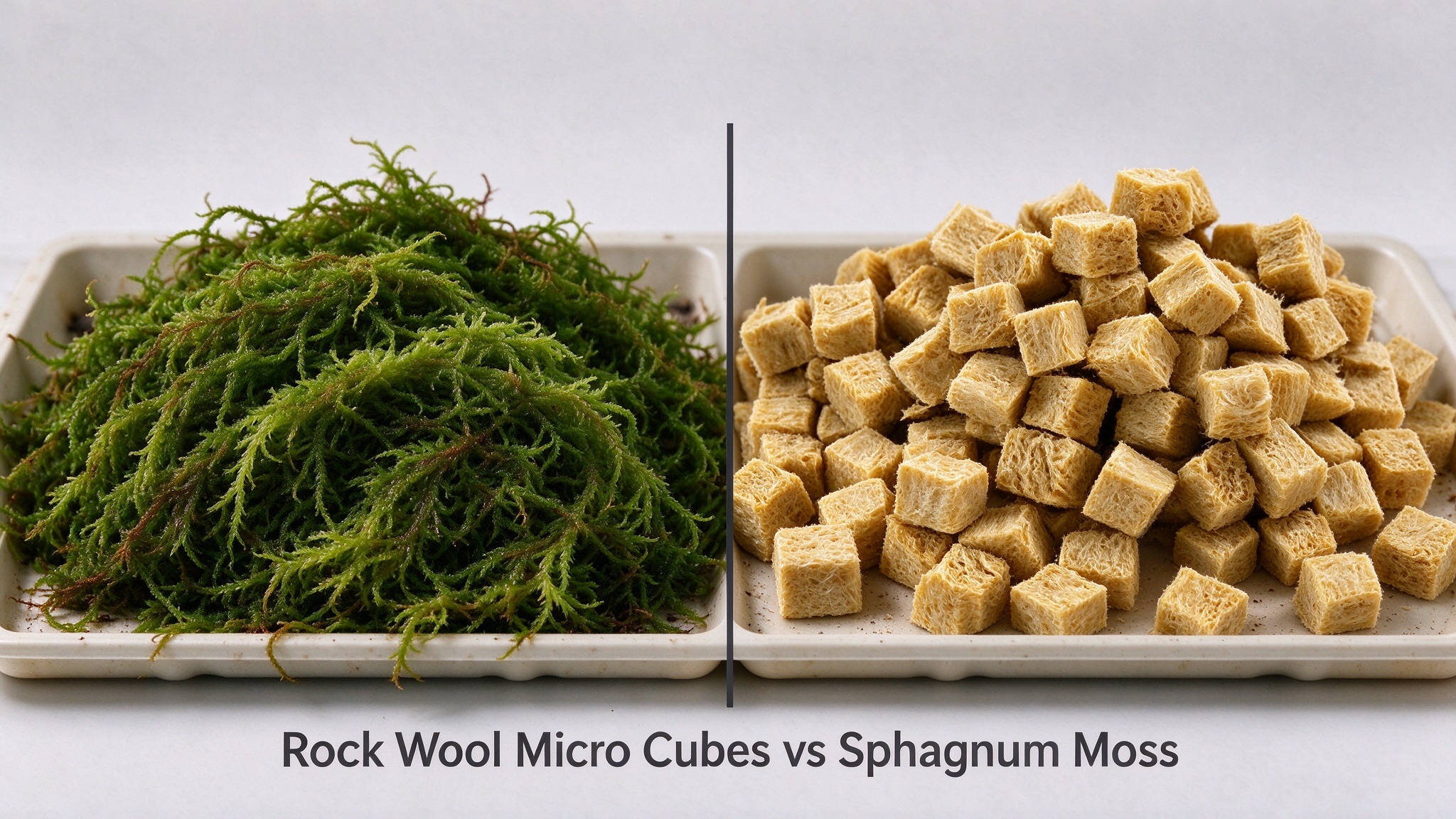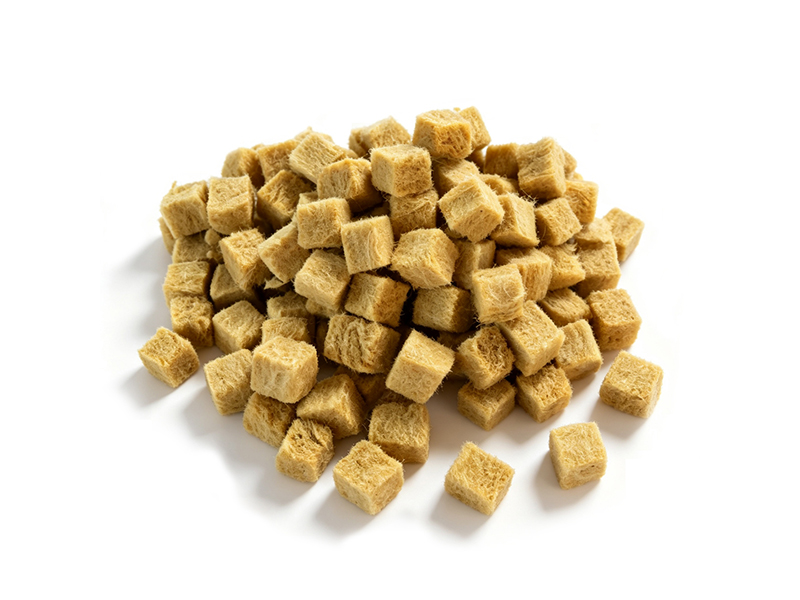

Orchid deflasking and acclimatization require a production system that protects young plantlets from excessive moisture loss while maintaining suitable root-zone aeration and drainage. Rock wool micro cubes for orchids such as GF-MC10 offer a loose, inorganic option whose internal fibre structure supports moisture distribution while the spaces between cubes contribute to an open root zone. Their suitability depends on crop type, container design, irrigation, humidity management and nursery conditions.
The Acclimatization Challenge
Moving tissue-culture plantlets from an in vitro vessel to an ex vitro greenhouse is a sensitive transition. In vitro plantlets develop under very high humidity, controlled light and aseptic laboratory conditions. After removal from the vessel, their leaves and roots must adjust to greater evaporative demand and a biologically active greenhouse environment.
Two root-zone requirements must be managed at the same time:
- Moisture protection. Tender roots, limited initial water uptake and incompletely adapted leaf surfaces can make newly deflasked plantlets vulnerable to rapid moisture loss.
- Root-zone aeration. Many commercially important orchids have roots adapted to open, well-aerated environments, often with a velamen layer. Root morphology and moisture requirements nevertheless vary among genera, species, hybrids and production stages.
If a medium remains persistently saturated or becomes compacted, oxygen availability and root function may decline. If it dries too quickly or makes poor contact with the roots, plantlets may experience moisture stress. The aim is not maximum water or maximum air, but a manageable balance during transition.
The Growing Medium Is Only One Part of Acclimatization
Successful acclimatization depends on more than substrate selection. Deflasked plantlets must gradually adjust to lower atmospheric humidity, higher transpiration demand, changing light levels and a non-sterile greenhouse environment. Root-zone moisture and aeration must therefore be managed together with canopy humidity, airflow, temperature, light and sanitation.
Rock wool micro cubes for orchids can help growers structure the root-zone component of this system, but they cannot compensate for excessive humidity reduction, poor hygiene, unsuitable light or incorrect irrigation.
How Rock Wool Micro Cubes for Orchids Function in the Root Zone
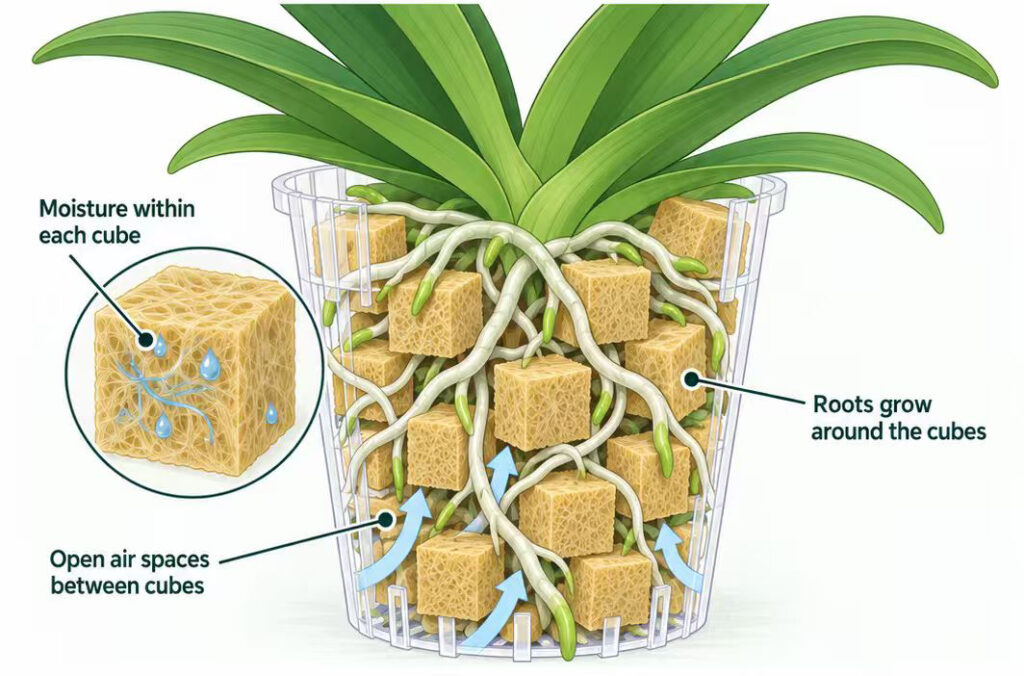
GF-MC10 consists of loose horticultural stone wool cubes with nominal dimensions of approximately 10 x 10 x 10 mm, or 0.4 inch. The root-zone structure is created by two related pore environments:
| Structural level | Function in the container | Management implication |
|---|---|---|
| Within-cube pore structure | Supports moisture distribution and contact with the applied nutrient solution | Requires complete and uniform pre-wetting before planting |
| Inter-cube spaces | Contribute to drainage and air-filled porosity under free-drainage conditions | Depend on container design, filling density and irrigation management |
Under suitable container and drainage conditions, excess irrigation solution can move toward the drainage openings while air returns to part of the pore space. This arrangement is designed to support an open root-zone structure, provided that filling density and irrigation are properly managed.
Key Operational Considerations
Repeatable Container Filling
Manually wrapping small roots with fibrous organic media requires skill and may produce operator-to-operator differences in packing density. The regular, free-flowing format of GF-MC10 allows workers to position the plantlet and settle cubes gently around the root system. This may support faster and more repeatable filling, but actual labour savings should be measured under the nursery's own workflow.
Resistance to Organic Decomposition
Organic substrates can soften and decompose under warm, humid production conditions, which may alter moisture distribution, drainage pathways and root-zone aeration during extended cycles. Stone wool does not biologically decompose in the same way and can retain its basic physical form through the acclimatization stage. Root growth, transport and handling can still change how the cubes settle in the container.
Nutrition and Irrigation Calibration
Rock wool contributes little nutrition of its own and has relatively low buffering capacity. Growers therefore retain direct control over nutrient inputs, while plant uptake, evaporation, irrigation uniformity and drainage can cause root-zone pH and EC to differ from the applied solution.
A sphagnum moss irrigation schedule should not be transferred directly to micro cubes. Nor should the direction of adjustment be assumed in advance. Irrigation frequency, application volume, misting strategy and drainage targets should be calibrated for the crop, container and greenhouse microclimate.
Pre-wetting and Initial Root-Zone Stabilization
Proper initial handling is essential before tender plantlets are placed into the medium. The objective is even wetting and suitable initial root-zone conditions, not an undefined acid-removal treatment.
- Prepare a crop-appropriate irrigation or conditioning solution suited to the nursery's source water and fertilizer programme.
- Thoroughly irrigate or soak the cubes until the fibre structure is evenly wetted.
- Allow free gravitational drainage. Do not wring, crush or heavily compact the cubes, as this may deform the material and change the way it settles in the container.
- Check the applied and drainage solution against the nursery's target pH and EC range before transplanting sensitive plantlets.
No single soaking duration, pH or EC target should be treated as universal across orchid crops. The starting strategy should be confirmed under the nursery's own water quality, fertilizer programme and plant stage.
Where Micro Cubes May Be Worth Evaluating
| Application context | What the nursery should evaluate |
|---|---|
| Tissue-culture deflasking | Initial root contact, moisture uniformity, drainage and plantlet establishment |
| Stage IV acclimatization | Humidity transition, irrigation response and new-root development |
| Perforated pots or community trays | Container depth, drainage openings, filling consistency and root distribution |
| Substrate blends | Particle interaction, packing density and resulting water-air behaviour |
| Export programmes | Current destination-specific plant and substrate requirements |
Substrate performance cannot be isolated from container depth, irrigation delivery, bench airflow and greenhouse humidity. Crop, hardware and climate must be evaluated as one system.
Frequently Asked Questions
Are Rock Wool micro cubes suitable for every orchid genus?
No growing medium is automatically suitable for every orchid genus or production stage. Evaluation should consider root morphology, plantlet size, growth habit, container design, humidity and irrigation. Epiphytic and terrestrial orchids may require different moisture and aeration strategies, and cultivars within the same genus can respond differently.
Do micro cubes prevent root rot during acclimatization?
No substrate can prevent root disease on its own. Root health is influenced by sanitation, climate, pathogen presence, plant condition and irrigation management. An open structure can support drainage and aeration, but it is only one part of disease-risk management.
Can deflasked plantlets be placed directly into dry cubes?
No. Dry cubes can create uneven initial moisture conditions and unreliable root-to-medium contact. The cubes should be thoroughly and uniformly pre-wetted before transplanting.
How should irrigation change when switching from sphagnum moss?
Rock wool micro cubes for orchids and sphagnum moss differ in structure, wetting and drainage behaviour. Do not transfer the existing moss schedule directly. Recalibrate irrigation frequency, application volume and misting strategy through a side-by-side trial.
How to Structure a Commercial Orchid Trial
A substrate transition should be evaluated under real nursery conditions before scale-up. Keep plant material, container type and greenhouse zone comparable, but allow each medium to receive an appropriately calibrated irrigation strategy. The objective is to compare two properly managed systems, not to force two different media into one identical watering schedule.
Useful trial observations include:
- Plantlet establishment and survival
- New-root initiation and active root-tip development
- Root colour and distribution through the container
- Moisture uniformity and drainage behaviour
- Irrigation input and management adjustments
- Filling time, labour requirement and plant uniformity
Detailed observation dates and pass-fail criteria should be defined before the trial begins and matched to the crop's commercial production cycle.
A Root-Zone Tool Not a Standalone Solution
Rock wool micro cubes for orchids are not a universal answer to orchid acclimatization. They are a root-zone tool that may help nurseries create a more open, inorganic and repeatable growing environment when container design, irrigation and canopy conditions are managed together.