
Practical ways to evaluate water retention, moisture distribution, consistency, and root-zone performance.

When comparing different rock wool brands, growers often focus on price, density, water-holding capacity, or brand reputation.
But does higher density necessarily mean better rock wool? Is a growing block that holds more water always better for plant growth? Not necessarily.
The right rock wool is not simply the product with the highest specifications. It is the one that meets the needs of your crop, its growth stage, and your growing system.
Different crops and growth stages require different root-zone conditions. A propagation plug, a growing block, and a production slab do not necessarily need the same characteristics. This article focuses on rock wool growing blocks, particularly those used during transplanting and early plant development.
A digital scale, a ruler, water, and careful observation can reveal useful differences without expensive laboratory equipment.
Check Size and Weight Consistency
For commercial growers, consistency is often just as important as individual product performance. Randomly select 10–20 blocks from each product you want to compare. Measure their length, width, height, and initial weight before wetting. Look for noticeable differences among blocks of the same product.
Significant dimensional variation may cause problems in automated handling, transplanting, and irrigation management. Large weight differences may also indicate variation in material content or manufacturing consistency. The goal is not to find the heaviest block, but to identify reliable consistency across multiple blocks.
Compare Water Uptake and Water-Holding Behavior
Water availability is one of the most important factors affecting root development. A simple weighing test can help compare how much water different blocks retain under the same conditions.
Record the initial weight of each block before wetting. Soak the blocks using the same procedure; allow them to drain for the same period; then weigh them again. The increase in weight provides a practical indication of water retained under those test conditions. Comparing blocks of the same measured dimensions is particularly useful.
Higher water retention does not automatically mean better performance.
A block that holds more water may suit one irrigation strategy, while a block with lower water retention may perform well under another. Relatively low retention can require more frequent irrigation and greater management effort. The real question is whether a block can maintain suitable moisture conditions within the grower’s practical irrigation capabilities.
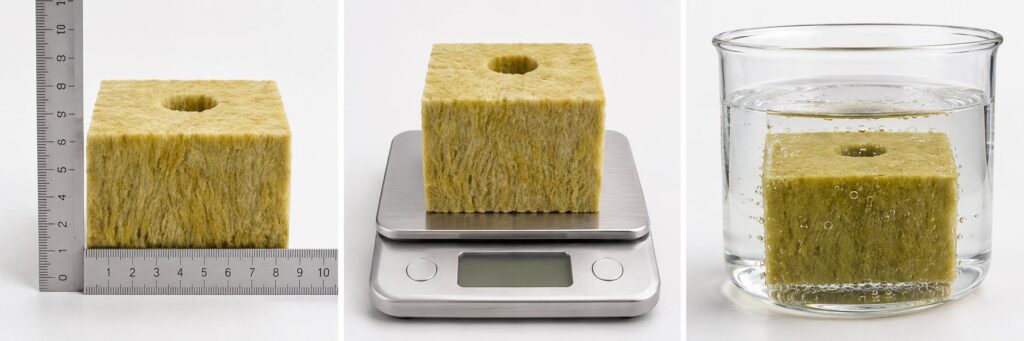
Figure 1. Measuring, weighing, and soaking rock wool blocks — illustrative demonstration, not measured test data.
Look for Uneven Wetting and Dry Areas
A growing block should allow irrigation water to reach the root zone effectively. Apply a measured amount of lightly colored water from the top, then carefully cut the block open and inspect the internal wetting pattern.
- Does water spread through the block or concentrate along particular paths?
- Do obvious dry areas remain?
- Does the upper section receive sufficient moisture?
- Does water drain through localized channels before adequately wetting surrounding material?
Some drainage is normal and necessary. The concern is excessive preferential flow that leaves important root-zone areas insufficiently wetted. This is a qualitative visual screening method, not a precise water-content measurement.
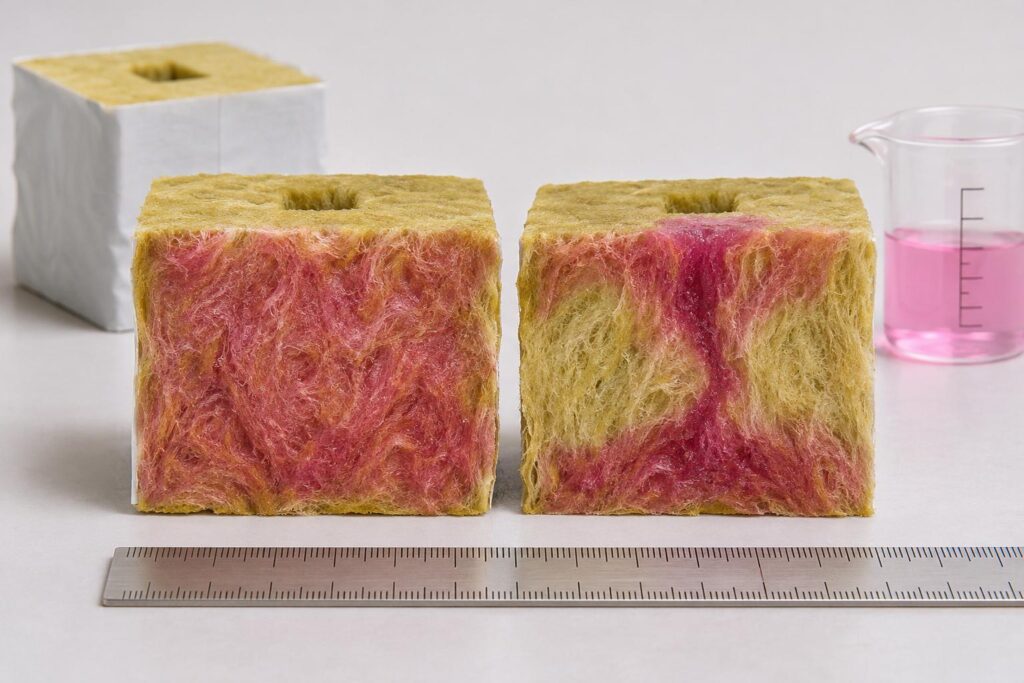
Figure 2. Conceptual comparison of distributed wetting and localized flow paths. AI-generated illustration; dye patterns are not experimental results.
Observe Moisture Distribution Through Surface Algae Growth
One practical way to compare growing blocks is to observe the amount and distribution of green algae on their surfaces. Based on practical growing experience, two patterns are particularly useful:
Higher water retention often leads to more algae growth.
Under the same growing conditions, rock wool blocks that retain more moisture tend to develop more green algae on their surfaces.
Uneven moisture distribution often results in uneven algae growth.
Where surface moisture is uneven, algae may develop more heavily in wetter areas and less in drier areas. These differences can be noticeable when products are compared side by side.
When rock wool products are used under comparable light, irrigation, nutrient supply, and environmental conditions, surface algae can provide visible clues about surface moisture and nutrient conditions. This is especially relevant during early transplanting, when moisture in the upper part of the block supports young root development.
Algae also responds to light, nutrients, temperature, and other factors. It should not be used as a precise moisture measurement or the sole indicator of product quality. Combined with weighing, wetting observations, and plant performance, however, it is a useful practical field indicator.
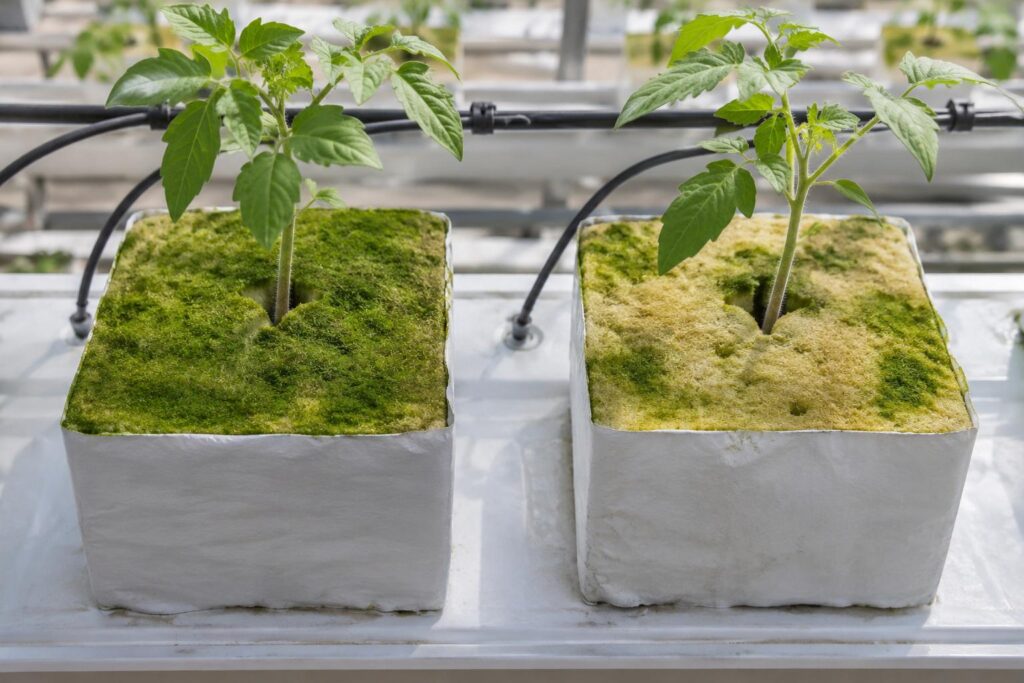
Figure 3. Illustrative surface algae patterns on growing blocks under greenhouse conditions. AI-generated; not evidence of a specific brand’s water retention.
Test Structural Stability After Soaking
Water performance is only part of the evaluation. For large-scale nurseries, particularly those using automated equipment, the physical stability of wet blocks is also important.
After soaking, check whether blocks retain their original shape. Handle, lift, and move them as they would be handled in production.
- Do they maintain their dimensions and shape?
- Do they become excessively soft or deform?
- Do they break apart or shed material easily?
- Do they fit and move reliably through existing automated equipment?
A block may retain water well yet still create operational problems if its wet structure is unsuitable. Handling reliability can affect labor requirements, production efficiency, and transplanting losses.
Let Plant Growth Complete the Evaluation
Simple physical tests help with initial screening, but they cannot replace actual growing observations. Conduct a small-scale trial using comparable seedlings, environmental conditions, and management practices.
- Root development and penetration into the growing block.
- Moisture conditions around the transplanting area.
- Plant growth and uniformity.
- Differences in irrigation requirements.
- Ease of handling and daily management.
- Overall plant performance during the observation period.
Different rock wool characteristics do not necessarily indicate differences in product quality.
A product may perform differently because its water-holding and drainage characteristics are not well matched to the irrigation practices being used. Consider both product properties and growing conditions before deciding whether a block is suitable.
A Practical Three-Stage Comparison
Stage 1 — Quick initial screening.
Measure dimensions and initial weights. Check appearance, consistency, and handling requirements.
Stage 2 — Water behavior observation.
Compare water uptake, retained weight, internal wetting patterns, and moisture changes over several days. Inspect wet structural stability.
Stage 3 — Small-scale growing trial.
Observe root development, plant uniformity, surface moisture and algae patterns, irrigation workload, and compatibility with the existing production system.
The goal is not to identify a universal winning brand. It is to identify the block that best meets the needs of a particular crop and production process.
Final Thoughts: Start with the Root Zone, Not the Brand
Every crop depends on its root zone for water, nutrients, and oxygen. Different growing stages place different demands on that environment. That is why comparing rock wool should begin with the needs of the plant rather than manufacturer specifications alone.
Density, water retention, consistency, and structural stability all matter, but their value depends on how they contribute to root-zone performance.
A suitable growing block should provide reasonably consistent root-zone conditions while remaining practical for the grower’s irrigation and production system.
By combining a few simple tests with careful growing observations, growers can make more informed decisions without relying entirely on brand reputation or laboratory data.