
A Practical Evaluation Framework for Commercial Nurseries and Tissue Culture Facilities
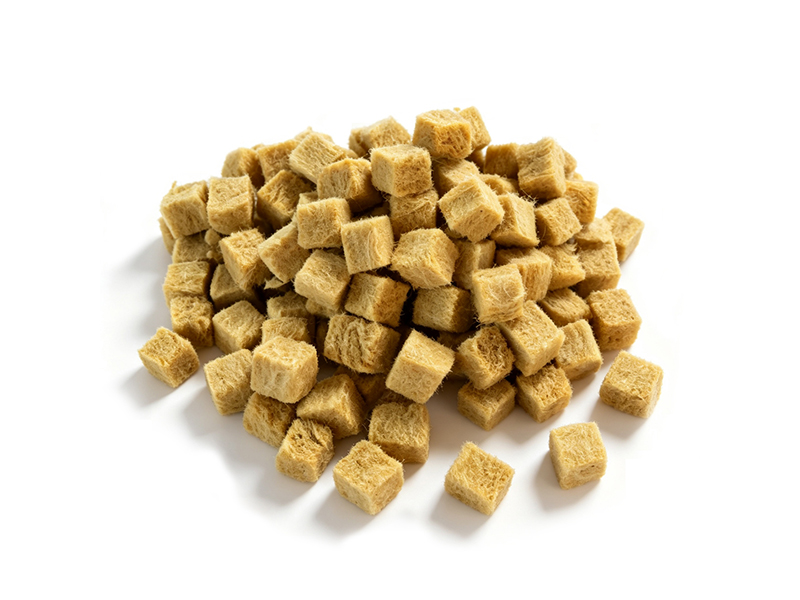
A commercial substrate change should be treated as a managed production-system decision rather than a simple material comparison. Orchid deflasking, young-plant acclimatization and container production are influenced by the interaction among substrate, container geometry, climate, sanitation and irrigation. A structured orchid substrate trial allows a nursery to determine whether a candidate medium such as GF-MC10 rock wool micro cubes can be integrated into its own workflow without exposing an entire crop to unnecessary risk.
The purpose of the trial is not to prove that one material is universally superior. It is to establish whether each properly managed root-zone system can meet predefined biological, operational and commercial objectives under the nursery's own conditions.
Define Success Before the Trial Begins
Before planting, define the criteria that will determine whether the candidate system stops, advances to a larger block or requires another calibration cycle. This prevents the final decision from being driven by isolated photographs or retrospective impressions.
- Minimum acceptable establishment or survival rate
- Target crop-uniformity range and maximum percentage outside the saleable grade
- Acceptable root-health and new-root-development scores
- Maximum labor time per 100 or 1,000 containers
- Acceptable irrigation, handling or equipment adjustments
- Maximum crop loss and target cost per marketable plant
Not every measure must improve for a new medium to be commercially useful. A candidate may justify further evaluation if it maintains crop quality while improving labor efficiency, process consistency, substrate stability or supply reliability.
Phase 1 Pretrial Controls and Experimental Design
Plant Material Consistency
- Use plants from the same clonal batch, deflasking cycle or grading class wherever possible.
- Do not mix cultivars, plant stages or markedly different vigor grades within one treatment comparison in your orchid substrate trial.
- Record the plant source, batch, deflasking date and any relevant pretrial handling.
Environmental Parity and Replication
- Place control and candidate treatments in the same greenhouse zone and within a comparable microclimate.
- Divide each treatment into several smaller replicated groups instead of placing all control plants on one side and all trial plants on the other.
- Randomize or alternate groups across the bench. Where practical, rotate trays according to a documented schedule to reduce positional bias.
- Record known differences in light, airflow, temperature, canopy humidity or irrigation exposure.
Replication helps separate a genuine treatment response from a local bench effect. The number of plants and replicates should reflect crop value, expected variability, nursery capacity and the commercial consequence of a wrong decision.
Container Geometry and Drainage
Container geometry influences how air and water are distributed through the root zone. In a shallow container, the wetter lower zone represents a larger proportion of the total substrate volume, while a taller container generally provides a greater vertical drainage gradient. Drainage-opening size, placement and bench contact also affect performance.
An initial screening orchid substrate trial may use the same container dimensions for both media to isolate substrate-related differences. If the candidate medium appears promising, a second optimization trial may evaluate the container and irrigation strategy best suited to each medium. Record container volume, depth, drainage configuration and filling method in both stages.
Control Unnecessary Variables
Avoid changing the substrate, container, fertilizer program, irrigation hardware and climate settings simultaneously during the first screening trial. Change only what is necessary to manage each medium correctly, and document every intentional adjustment. Otherwise, the trial may show that the overall system changed without revealing which variable caused the response.
Phase 2 Independent Irrigation Calibration
The most common substrate-trial error is forcing two structurally different media into one watering schedule. That approach tests compatibility with the existing schedule rather than the biological and commercial potential of the candidate medium.
| Approach | What it tests | Interpretation |
|---|---|---|
| Use the existing moss schedule for both treatments | Whether the candidate tolerates a schedule developed for another medium | A weak result may reflect schedule mismatch rather than unsuitable material |
| Calibrate each medium independently | Whether each properly managed root-zone system can meet the same commercial objectives | Supports a fair system-level comparison |
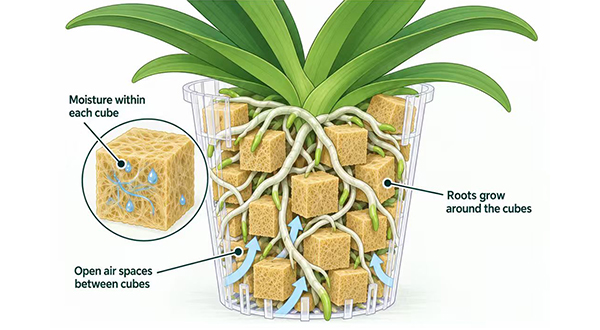
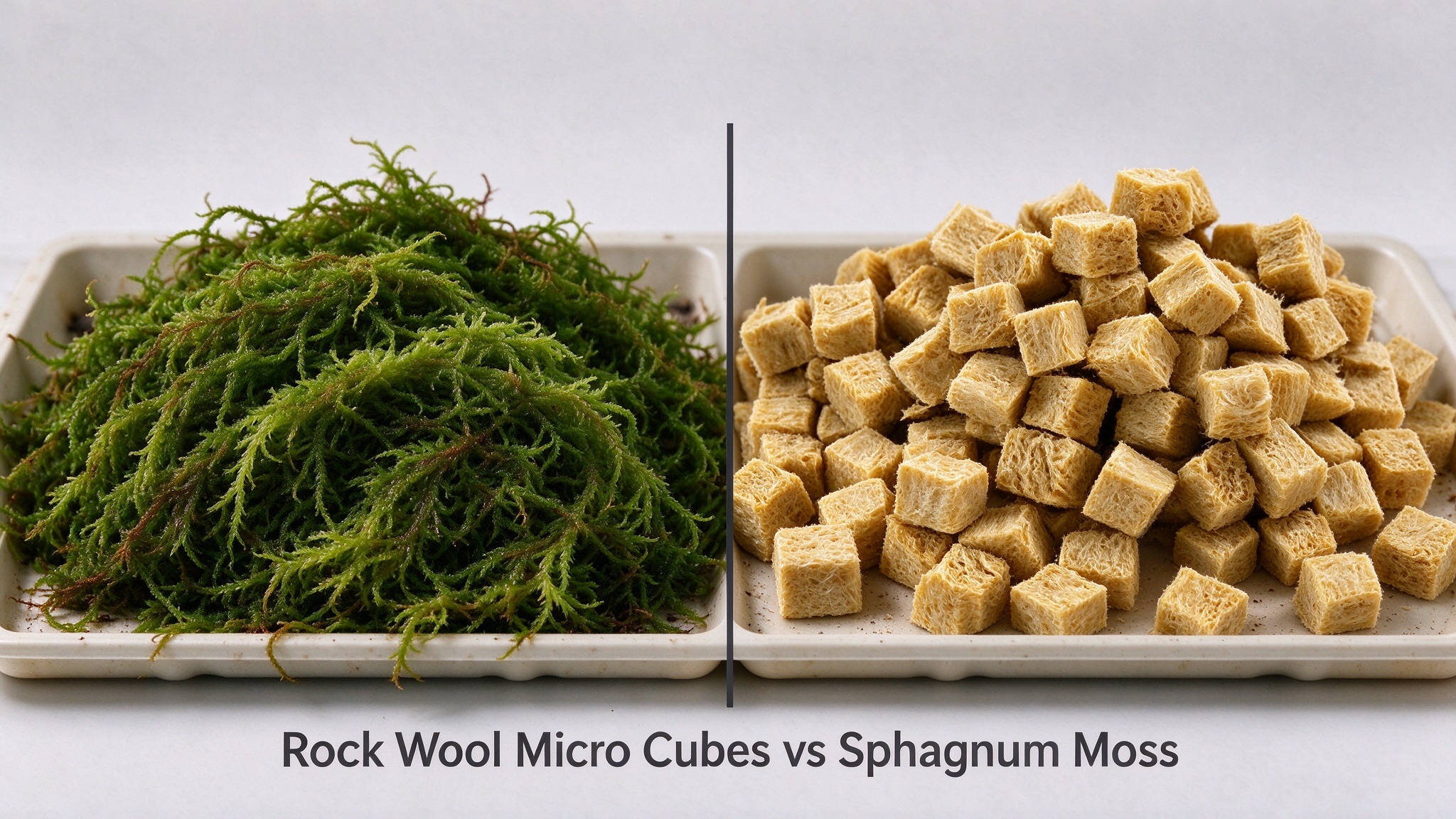
Sphagnum moss holds water through a dense fibrous structure and follows its own wetting and dry-down pattern. Learn more in our side-by-side sphagnum moss vs rock wool micro cubes comparison.In rock wool micro cubes, water is retained within the pore network of each cube, while the larger spaces between adjacent cubes provide pathways for drainage and air exchange.
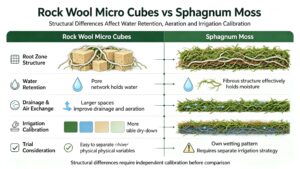
GF-MC10 may therefore require different application volumes, irrigation intervals, delivery methods or dry-down targets. The direction and magnitude of adjustment should be determined through observation and measurement rather than assumed in advance. The comparison should keep the commercial objective consistent while allowing each medium to be managed appropriately.
Phase 3 Evaluation Metrics
Use a predefined observation sheet, fixed assessment dates and consistent scoring criteria for your orchid substrate trial. Photographs should be taken from comparable positions and under similar lighting. If roots must be removed from containers for assessment, define a separate destructive-sampling group so that repeatedly disturbed plants do not remain in the main performance dataset.
| Evaluation category | Suggested indicators | Recommended records |
|---|---|---|
| Establishment and survival | Survival; transplant shock; leaf turgor; visible canopy stress | Plant counts and standardized photographs at predefined intervals |
| Root development | New-root emergence; active root tips; branching; root color and distribution | Consistent root-score sheet and destructive sampling of a predefined subset |
| Root-zone behavior | Wetting uniformity; dry-down pattern; drainage behavior | Container weights, irrigation records and visual observations |
| Nutritional monitoring | Applied and drainage or extract pH and EC where relevant | Use one documented sampling method and evaluate trends rather than isolated readings |
| Crop uniformity | Plant size; leaf number; crop-specific grading indicators | Average, range and percentage of plants outside the target grade |
| Labor and operations | Preparation, filling, transplanting and cleanup time; operator variation | Labor minutes per 100 or 1,000 containers and observed workflow constraints |
| Commercial outcome | Crop loss; material consumption; labor input; marketable yield | Estimated total cost per marketable plant |
Where pH and EC are monitored, use a consistent and documented sampling method throughout the trial. Drainage, pour-through and laboratory extraction results should not be treated as interchangeable. Compare trends against the nursery's crop-specific operating range and use them to identify possible uneven nutrient delivery or salt accumulation.
Establish Intervention and Stop Criteria
Define in advance when corrective action, additional investigation or early termination is required. Relevant triggers may include:
- Rapid or widespread loss of plant turgor
- Unexpected root-tip injury or discoloration
- Disease symptoms above the nursery's intervention threshold
- Severe wetting non-uniformity or inadequate drainage
- pH or EC trends outside the facility's crop-specific operating range
Date and record every intervention, including changes to irrigation, nutrition, humidity or crop protection. The final analysis should reflect how each system was actually managed, not only its condition at the end of the trial.
Phase 4 Staged Scale Up
The following sizes and durations are planning examples rather than universal prescriptions. Adjust them for orchid genus, plant stage, crop cycle, expected variability, facility capacity and commercial risk for your orchid substrate trial.
| Stage | Primary purpose | Typical scope and decision |
|---|---|---|
| Tier 1 Micro pilot | Confirm handling, prewetting and initial irrigation calibration | A limited batch, often about 100 to 300 plantlets; stop, recalibrate or advance after establishment review |
| Tier 2 Block validation | Evaluate seasonal response, labor throughput, uniformity and root-zone stability | One or more replicated bench blocks; continue through a meaningful nursery phase |
| Tier 3 Commercial integration | Validate scheduling, purchasing, training and routine quality control | A dedicated production block introduced under normal operating procedures before broader adoption |
Do not scale solely because early survival is acceptable. Advancement should consider root development, crop uniformity, labor performance, management complexity and cost per marketable plant. Seasonal validation may be necessary if the greenhouse experiences meaningful shifts in temperature, humidity, light or water demand.
A Clean and Hygienic Starting Point
Produced from mineral raw materials through a high-temperature melting process, fresh stone wool provides a clean, inorganic and hygienic starting point for propagation. Unlike harvested organic media, it does not inherently introduce decomposing plant material, weed seeds or soil residues. This can help growers reduce the biological variability and contamination risks associated with naturally sourced organic materials. Appropriate handling, storage and nursery sanitation remain essential because the finished product is not supplied as a sterile growing medium.
Frequently Asked Questions
How long should an orchid substrate trial run
Early establishment responses may become visible within several weeks, but the trial should continue long enough to capture meaningful root development, crop uniformity and at least one relevant production transition. For many nurseries, this means observing a defined acclimatization or nursery phase rather than stopping when initial survival is known. Trial duration should be matched to the orchid type, plant stage and decision being made.
Do we need specialized sensors
No. Continuous moisture and EC sensors can provide high-resolution data, but an initial commercial trial can also use regular container weighing, irrigation records, standardized observations and handheld pH and EC meters. The value of any reading depends on consistent sampling and interpretation.
Should both media receive exactly the same irrigation
No. They should experience comparable environmental conditions and be judged against the same commercial objectives, but each medium should receive an appropriately calibrated irrigation strategy. Any differences in management must be documented.
Can rock wool micro cubes be reused after a trial cycle
Although stone wool does not biologically decompose like organic media, reuse is generally not recommended in commercial propagation and young-plant production. Used media may contain residual roots, accumulated salts or contaminants introduced during cultivation. Fresh, unused stone wool provides a cleaner and more consistent starting point, but it should not be interpreted as a sterile growing medium unless specifically tested, treated and certified as such.
Moving From Concept to Commercial Evidence
A useful commercial trial replaces assumption with documented evidence. By controlling unnecessary variables, using replicated treatment groups, calibrating irrigation independently and evaluating biological, operational and financial outcomes, a nursery can determine whether rock wool micro cubes fit its production objectives and what must change before scale-up.